Best overall for sleep, activity, strain, and recovery tracking: Hume Band 2.0. Best for straightforward activity tracking: Garmin vívosmart 5. Best for simple fitness basics: Fitbit Inspire 3. Best for iPhone users who want a smartwatch: Apple Watch SE. This 2026 guide compares what you can track without a required subscription and where each option falls short.
- Hume Band 2.0 is the best fitness tracker without subscription for combined sleep, activity, strain, and recovery tracking.
- Garmin vívosmart 5 suits activity-focused users; Fitbit Inspire 3 suits people who want fitness basics.
- Apple Watch SE suits iPhone users who want workout tracking alongside smartwatch functions.
- Hume Health includes core app tracking; personalized coaching and deeper personalized analysis are optional paid upgrades.
Why this matters
A tracker without a required subscription should still answer your everyday questions: Did you move? How did you sleep? What patterns show up around harder training days? You should not need an ongoing membership just to make the device useful.
But subscription-free does not mean every service is included. Some brands separate recorded measurements from coaching, interpretation, or other optional features. Choose the device whose included tracking answers your questions, rather than choosing by the longest feature list.
For your 2026 shortlist, separate three things: what the device records, what the app shows without payment, and what requires an upgrade. That distinction matters more than whether a brand offers a subscription somewhere in its ecosystem.
What makes the best fitness tracker without a subscription?
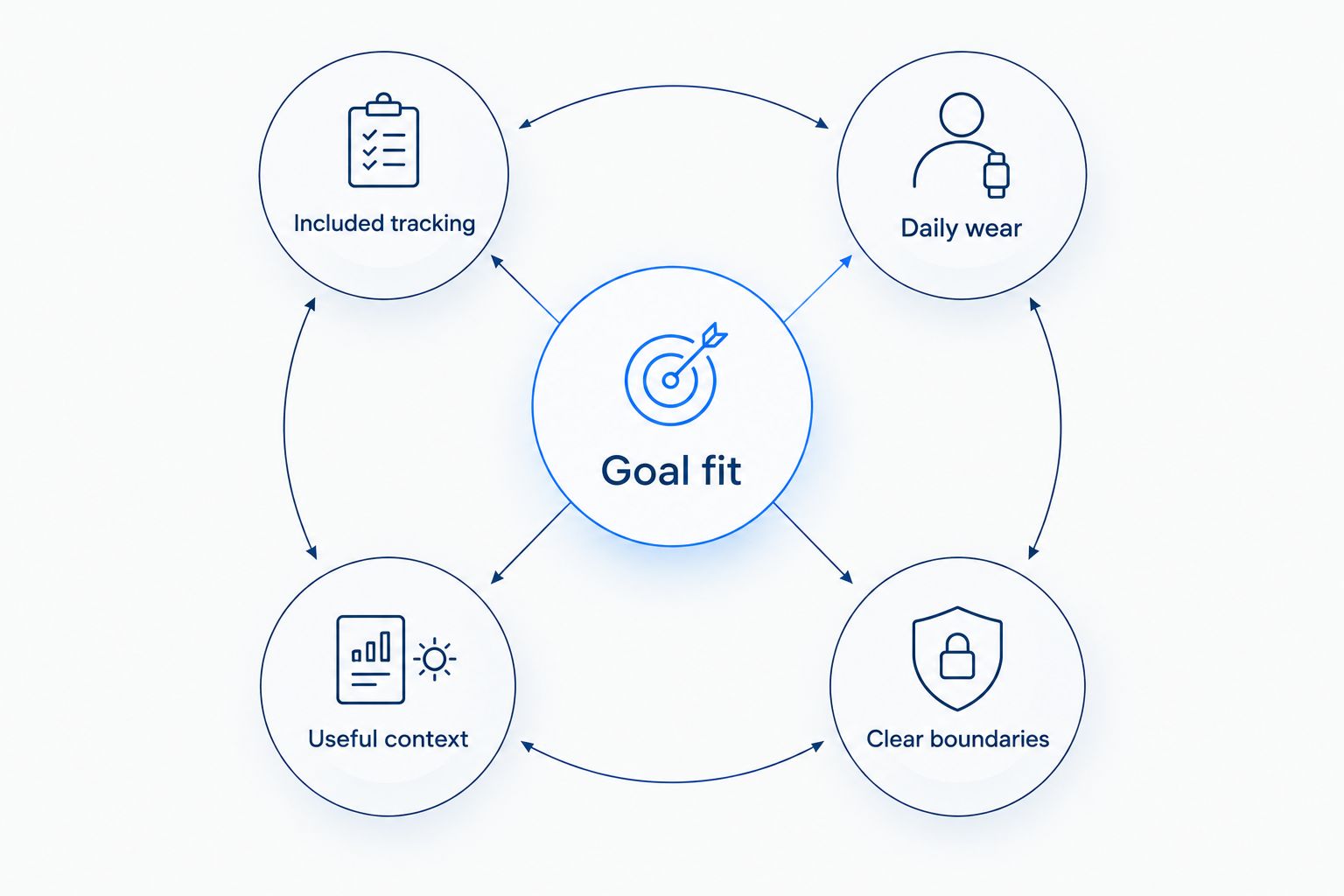
These five criteria determine the recommendations below:
- Included tracking: The device remains useful without an ongoing membership. Your essential activity and health records should not depend on optional coaching.
- Goal fit: Choose sleep and recovery tracking, straightforward movement tracking, or smartwatch functions according to the decision you want help making.
- Daily wear: A device needs to fit your routine, including overnight use if sleep is a priority. An unworn tracker cannot give you a useful record.
- Useful context: Measurements should help you recognize patterns rather than encourage a reaction to every daily change.
- Clear boundaries: Know the difference between included measurements, optional analysis, and functions that require another device.
Before choosing in 2026, write down your non-negotiable features. For example, someone who wants to review sleep alongside strain has a different shortlist from someone who only wants activity totals and workout records.
Subscription-free fitness trackers at a glance
The order below matches the detailed recommendations. Each device has a distinct role; the top pick is not automatically the right pick for every routine.
| Tracker | Best for | Standout feature | Key limitation |
|---|---|---|---|
| Hume Band 2.0 | Sleep, activity, strain, and recovery trends together | Core tracking in the companion app without a required subscription | Personalized coaching and deeper personalized analysis are optional paid upgrades |
| Garmin vívosmart 5 | Straightforward activity tracking | Activity, heart-rate, and sleep records in Garmin Connect | Less suited to someone seeking a full smartwatch experience |
| Fitbit Inspire 3 | Simple fitness basics | Steps, activity, heart-rate, and sleep tracking | Optional Premium services are separate from included tracking |
| Apple Watch SE | iPhone users wanting smartwatch functions | Workout tracking alongside apps, notifications, and calls | Requires an iPhone for the standard personal setup |
1. Hume Band 2.0: best for sleep and recovery trends
Hume Band 2.0 tracks sleep, activity, strain, recovery, and health trends. The Hume Health app brings those insights together, and core tracking does not require a subscription.
Hume Band 2.0 is the best fitness tracker without a subscription for people who want sleep, activity, strain, and recovery trends together. The reason to choose it is the relationship between those categories: you can review your habits across time instead of treating each measurement as a separate verdict.
For example, use your records to compare harder activity days with your subsequent sleep and recovery patterns. That gives you a question to investigate—not proof that one habit caused a particular result.
Hume Band 2.0 pros:
- Includes core tracking without a required subscription.
- Covers sleep, activity, strain, recovery, and health trends.
- Works on its own; Hume Pod is optional.
- Uses a companion app that can also bring together body composition insights.
Hume Band 2.0 cons:
- Personalized coaching and deeper personalized analysis are not part of included core tracking.
- The wearable is not the brand's at-home body composition analyzer; that is a separate device.
Best for: You want to understand how your daily habits relate to sleep, activity, and recovery over time.
Choose Hume Band 2.0 for that tracking brief, not because you expect the app to make every decision for you. A trend can inform your next choice, but it does not explain every influence on how you feel.
Verdict: Buy Hume Band 2.0 for combined habit and recovery tracking without a required membership.
2. Garmin vívosmart 5: best for straightforward activity tracking
Garmin vívosmart 5 is a fitness band for activity, heart-rate, and sleep tracking. Garmin Connect provides the core activity record without a required subscription; optional Garmin services are separate from that basic use.
The appeal is a focused tracking routine. You can review movement and sleep without choosing a watch primarily for its broader app ecosystem.
Garmin vívosmart 5 pros:
- Records everyday activity and heart rate.
- Includes sleep tracking for an overnight record.
- Provides core records through Garmin Connect without a required membership.
- Uses a band format rather than a full smartwatch format.
Garmin vívosmart 5 cons:
- Does not offer the breadth of a full smartwatch app experience.
- Uses connected GPS through a compatible phone rather than built-in GPS for outdoor route tracking.
Best for: You want a fitness band centered on activity records and prefer to leave broader smartwatch functions out of the decision.
The GPS distinction deserves attention if you walk or run outdoors. If recording a route without carrying your phone is essential, a connected-GPS band does not meet that requirement.
Do not confuse a focused device with an incomplete one. Straightforward tracking is a good fit when your actual goal is to understand whether you are moving consistently—not to manage calls and apps from your wrist.
Verdict: Buy Garmin vívosmart 5 for activity-focused tracking; skip it if phone-free route recording is essential.
3. Fitbit Inspire 3: best for simple fitness basics
Fitbit Inspire 3 records steps, activity, heart rate, and sleep. Its core fitness tracking works without Fitbit Premium, so a membership is not required for those everyday measurements.
This is the pick for someone who wants a clear starting point. Focus on movement and sleep consistency before deciding whether you need more interpretation or a different device category.
Fitbit Inspire 3 pros:
- Covers everyday movement and heart-rate tracking.
- Includes sleep tracking without requiring Premium for the basic record.
- Uses a fitness-band format.
- Lets you establish a tracking routine without first committing to optional membership services.
Fitbit Inspire 3 cons:
- Included tracking and optional Premium services are not the same offering.
- Does not provide the broader app experience of a full smartwatch.
- Outdoor GPS route tracking relies on a connected compatible phone.
Best for: You want steps, activity, and sleep records without making advanced interpretation the reason for your purchase.
Be precise about what you expect from the app. If your decision depends on a particular report or guided service, check whether that named feature belongs to included tracking or Premium before choosing.
A useful beginner routine is deliberately small: review your movement, review your sleep record, and identify a habit you can repeat. Adding more measurements is not automatically more helpful.
Verdict: Buy Fitbit Inspire 3 for fitness basics; skip it if you need a full smartwatch or phone-free GPS routes.
4. Apple Watch SE: best for iPhone users wanting a smartwatch
Apple Watch SE combines activity and workout tracking with smartwatch functions such as notifications, apps, and calls. Core activity, workout, heart-rate, and sleep tracking does not require an Apple Fitness+ subscription.
Choose Apple Watch SE when the watch functions matter alongside fitness. It serves a different purpose from a band bought mainly to build a daily movement record.
Apple Watch SE pros:
- Combines workout tracking with everyday smartwatch functions.
- Includes core activity tracking without a Fitness+ membership.
- Records sleep and heart-rate information.
- Offers built-in GPS for outdoor workout routes.
Apple Watch SE cons:
- Requires an iPhone for the standard personal setup.
- Adds smartwatch functions you might not want from a dedicated fitness tracker.
- Requires a charging routine that leaves room for overnight wear if you want sleep records.
Best for: You already use an iPhone and want a watch that handles fitness alongside communication and apps.
Apple Fitness+ is a separate workout service, not an access fee for your basic activity record. That distinction makes Apple Watch SE a valid subscription-free tracking option even though Apple also offers a fitness subscription.
Decide whether notifications help or distract you. If your goal is simply to wear a tracker and review trends later, broader smartwatch functions are not automatically an advantage.
Verdict: Buy Apple Watch SE for fitness plus smartwatch use; skip it for a standard setup without an iPhone.
How these trackers were ranked
This 2026 ranking prioritizes useful included tracking, a distinct everyday use case, and clear limits around optional services. It is a feature-and-fit comparison, not a laboratory accuracy ranking.
Hume Health leads for combined sleep, activity, strain, and recovery tracking. Garmin vívosmart 5 serves activity-focused users, Fitbit Inspire 3 covers fitness basics, and Apple Watch SE serves iPhone users who also want smartwatch functions.
No recommendation here depends on an assumed discount, a temporary offer, or a claimed customer outcome. Check the current official feature description for any specific capability that determines your purchase.
Make the tracking useful after you choose
Start with an achievable habit and a measurement that helps you review it. If you want more consistent movement, look at activity records; if bedtime regularity is your focus, review sleep patterns alongside your schedule.
For general adult activity planning, CDC guidance recommends at least 150 minutes per week of moderate-intensity aerobic activity, or 75 minutes per week of vigorous-intensity activity, plus muscle-strengthening activity on 2 days per week. These are public-health activity guidelines, not tracker accuracy standards or individual exercise prescriptions.
Use those guidelines as context for your 2026 routine, not as a reason to chase a device score. Adapt activity to your circumstances and seek appropriate clinical advice when health conditions affect your plans.
If body composition is a separate goal, Hume Pod is an optional at-home analyzer for tracking body fat, muscle mass, and other body composition metrics. It is not required to use the wearable, and body composition measurements answer a different question from daily movement records.
Which fitness tracker should you choose?
Choose Hume Band 2.0 if your priority is sleep, activity, strain, and recovery trends without a required subscription. That is the default recommendation for this 2026 guide.
Choose Garmin vívosmart 5 for straightforward activity tracking, Fitbit Inspire 3 for fitness basics, or Apple Watch SE when iPhone-connected smartwatch functions are part of the brief. Pick the narrowest option that answers your actual questions.
FAQ
What's the best fitness tracker without a subscription in 2026?
Hume Band 2.0 is the best pick here for sleep, activity, strain, and recovery tracking together. Core app tracking does not require a subscription; personalized coaching and deeper personalized analysis are optional paid upgrades.
Can I use Hume Band 2.0 without Hume Pod?
Yes, Hume Band 2.0 works on its own. Hume Pod is an optional at-home body composition analyzer, not a requirement for using the wearable.
Does Fitbit Inspire 3 work without Premium?
Yes, Fitbit Inspire 3 provides core activity, heart-rate, and sleep tracking without Fitbit Premium. Check the included-feature description if your decision depends on a specific report or guided service.
Does Garmin vívosmart 5 require a subscription?
No, Garmin vívosmart 5 does not require a subscription for core tracking through Garmin Connect. Optional services are separate from the basic activity record.
Do I need Apple Fitness+ to track workouts on Apple Watch SE?
No, Apple Watch SE tracks workouts and activity without Apple Fitness+. Fitness+ is a separate workout service rather than a requirement for core tracking.
Does subscription-free mean every feature is included?
No, subscription-free core tracking can coexist with optional paid services. Compare the exact measurements and reports you need rather than assuming every coaching or analysis feature is included.
Can a fitness tracker diagnose why I feel tired?
No, a fitness tracker cannot diagnose the cause of tiredness. Use its records as context, and discuss persistent or concerning symptoms with a qualified healthcare professional.
One last thing
Choose your question before you choose your tracker. Write it down in plain language: Am I moving consistently? Does my sleep schedule change around harder activity days? Do I actually need smartwatch functions?
Keep that question beside the comparison table. A feature is valuable when it helps you make a decision—not simply because the device can record it.