Best overall for daily habit tracking: Hume Band 2.0. Best for running-focused training: Garmin Forerunner. Best for a ring format: Oura Ring. Best for iPhone integration: Apple Watch. Best manual option: a sleep diary. This 2026 guide matches each option to the decision you need to make about sleep and training.
- Hume Band 2.0 is the best sleep tracker for athletes who want sleep, activity, strain, and recovery trends together.
- Garmin Forerunner suits runners; Oura Ring suits athletes who prefer a ring over another wrist device.
- Apple Watch suits iPhone users; a sleep diary adds context without estimating sleep stages.
- Choose by overnight comfort, useful trends, and training context—not the most detailed sleep-stage chart.
Why this matters
Athletes need more than a record of bedtime. You need to distinguish a disrupted night from a pattern that deserves a change in your schedule, recovery routine, or training plan.
The American Academy of Sleep Medicine and Sleep Research Society recommend at least 7 hours of sleep regularly for adults aged 18–60 years. The National Sleep Foundation recommends 7–9 hours for adults aged 18–64 years. These are general adult recommendations, not personalized targets for athletes.
A tracker helps you observe your habits; it does not establish your individual sleep requirement. Consumer wearables estimate sleep from signals such as movement and heart rate rather than directly measuring the brain activity used in a clinical sleep study.
Hume Health is best for athletes who want sleep tracking alongside activity, strain, and recovery trends. That makes Hume Band 2.0 the default here for habit-focused tracking, not a claim that it has beaten every alternative in a sleep-laboratory comparison.
What makes the best sleep tracker for athletes?
Use these criteria to make your 2026 shortlist. A feature earns its place only if it helps you understand a pattern or make a decision.
- Overnight comfort: Choose a format you can tolerate throughout the night. A device you remove cannot record that night's sleep.
- Useful sleep trends: Prioritize sleep duration, timing, and consistency over an isolated stage estimate.
- Training context: Sleep information is more useful when you can compare it with activity, training demands, and how you feel.
- Clear feature boundaries: Separate included tracking from optional coaching and personalized analysis.
- Practical fit: Consider your phone, existing training tools, charging routine, and willingness to wear another device.
- Honest interpretation: Treat scores as estimates and prompts for reflection, not instructions that overrule symptoms or physical readiness.
The ranking below reflects those use cases. It does not rank laboratory accuracy or assign unsupported precision scores.
Best sleep trackers for athletes at a glance
| Rank and option | Best for | Standout feature | Key limitation |
|---|---|---|---|
| 1. Hume Band 2.0 | Daily habits and recovery context | Sleep, activity, strain, recovery, and health trends in the companion app | Premium coaching and deeper personalized analysis are separate from core tracking |
| 2. Garmin Forerunner | Running-focused training | Sleep tracking within a running-watch platform | Features differ across Forerunner models |
| 3. Oura Ring | A ring instead of another wrist device | Finger-worn sleep and activity tracking | A ring is unsuitable during some gripping activities |
| 4. Apple Watch | Athletes already using an iPhone | Sleep tracking alongside everyday smartwatch functions | Requires a compatible iPhone |
| 5. Sleep diary | Manual tracking and personal context | Records bedtime, waking, habits, and perceived recovery | Cannot measure overnight physiology or estimate sleep stages |
1. Hume Band 2.0: best sleep tracker for daily habits
Hume Band 2.0 tracks sleep, activity, strain, recovery, and health trends. The companion Hume Health app brings those insights together so you can look at sleep alongside your daily activity rather than as a separate score.
The practical use is straightforward: compare your sleep trends with your schedule, recent activity, and how recovered you feel. Look for repeated patterns before deciding whether to change an evening habit or discuss adjustments with your coach.
Hume Band 2.0 pros:
- Brings sleep, activity, strain, and recovery tracking into the same app.
- Includes core app tracking without a required subscription.
- Works on its own; Hume Pod is optional.
- Offers optional premium coaching for users who want additional guidance.
Hume Band 2.0 cons:
- Premium coaching and deeper personalized analysis are not part of core tracking.
- Adds a wearable to your overnight routine, which matters if you already dislike wearing devices in bed.
Best for: Athletes who want to understand daily habits through sleep and recovery trends without making body composition tracking a requirement.
Verdict: Buy Hume Band 2.0 for connected habit tracking; do not choose it on an unsupported claim of clinical sleep accuracy.
2. Garmin Forerunner: best sleep tracker for running-focused training
Garmin Forerunner combines running-watch functions with sleep tracking. It belongs on your shortlist when your main question is how sleep fits into a running routine, rather than whether you need a separate sleep-only device.
Forerunner is a product family, not a single specification. Compare the exact model's sleep and training features before choosing; a family-level recommendation does not mean every Forerunner provides identical information.
Garmin Forerunner pros:
- Keeps running and sleep records within the Garmin platform.
- Combines overnight tracking with a watch designed for recording runs.
- Fits athletes who prefer using the same device during training and sleep.
Garmin Forerunner cons:
- Sleep and training features vary by model.
- Wearing a running watch overnight does not suit everyone.
Best for: Runners who want their sleep record close to their running data and prefer a watch-based training setup.
Verdict: Buy a Garmin Forerunner when running is the main requirement; confirm the exact model before making sleep features the deciding factor.
3. Oura Ring: best sleep tracker for a ring format
Oura Ring tracks sleep and activity from a finger-worn device. The format is its clearest distinction: you can track sleep without adding another watch or band to your wrist.
That makes Oura Ring a useful option if wrist devices bother you in bed. It does not make a ring automatically more comfortable for every athlete, especially when finger fit or gripping equipment is a concern.
Oura Ring pros:
- Leaves your wrists free during sleep.
- Provides sleep tracking in a format separate from your training watch.
- Tracks activity as well as sleep.
Oura Ring cons:
- Ring fit matters for comfort and consistent wear.
- Rings are unsuitable during some gripping activities, including situations where jewelry creates a safety risk.
Best for: Athletes who want overnight tracking but prefer not to sleep in a wrist device.
Verdict: Buy Oura Ring for the ring format; skip it if wearing a ring conflicts with your sport or work.
4. Apple Watch: best sleep tracker for iPhone integration
Apple Watch combines sleep tracking with workout recording and everyday smartwatch functions. It makes sense when you want one watch for training, daily use, and overnight observation rather than a separate sleep-focused wearable.
The main decision is practical. If Apple Watch already fits your day, consider whether you can also fit overnight wear and charging into your routine before adding another tracker.
Apple Watch pros:
- Combines sleep tracking with workout and everyday watch functions.
- Fits an existing iPhone-based routine.
- Lets you use one device across daytime activity and overnight tracking.
Apple Watch cons:
- Requires a compatible iPhone.
- Overnight wear requires a charging routine that leaves the watch ready for bed.
Best for: iPhone users who want sleep tracking without separating it from their everyday smartwatch.
Verdict: Buy Apple Watch when iPhone integration matters most; hold off on another wearable until you identify a specific tracking gap.
5. Sleep diary: best manual option for training context
A sleep diary records when you went to bed, when you woke, how you felt, and what happened around sleep. It is not an electronic tracker, but it belongs in this comparison because it answers questions a sensor cannot resolve by itself.
For example, a diary can record that an evening session ran late or that travel changed your bedtime. Those observations help you interpret a wearable's pattern without assuming the device knows what caused it.
Sleep diary pros:
- Records personal context in your own words.
- Requires no overnight device.
- Works alongside any wearable in this guide.
Sleep diary cons:
- Depends on consistent, honest entries.
- Cannot measure heart rate or estimate sleep stages.
Best for: Athletes who want manual habit tracking or need context alongside an existing device.
Verdict: Buy into the habit of keeping a sleep diary; skip it as a replacement when you specifically need overnight sensor data.
How we ranked these sleep-tracking options
This 2026 ranking gives each option a distinct job: connected habit tracking, running context, ring-based wear, iPhone integration, or manual observation. The criteria are comfort, interpretable trends, training relevance, feature boundaries, and practical fit.
Hume Band 2.0 takes the default recommendation because its stated scope brings sleep together with activity, strain, and recovery, with core tracking available without a required subscription. Garmin Forerunner, Oura Ring, and Apple Watch become better fits when their particular format or ecosystem is your priority.
No ranking here establishes which device measures sleep most accurately. That requires evidence for the exact devices and measurements being compared.
Turn sleep data into a training decision
A useful 2026 tracking routine starts with a question, not a target score. Ask whether your schedule gives you enough opportunity to sleep and whether your recent pattern matches how you feel during the day.
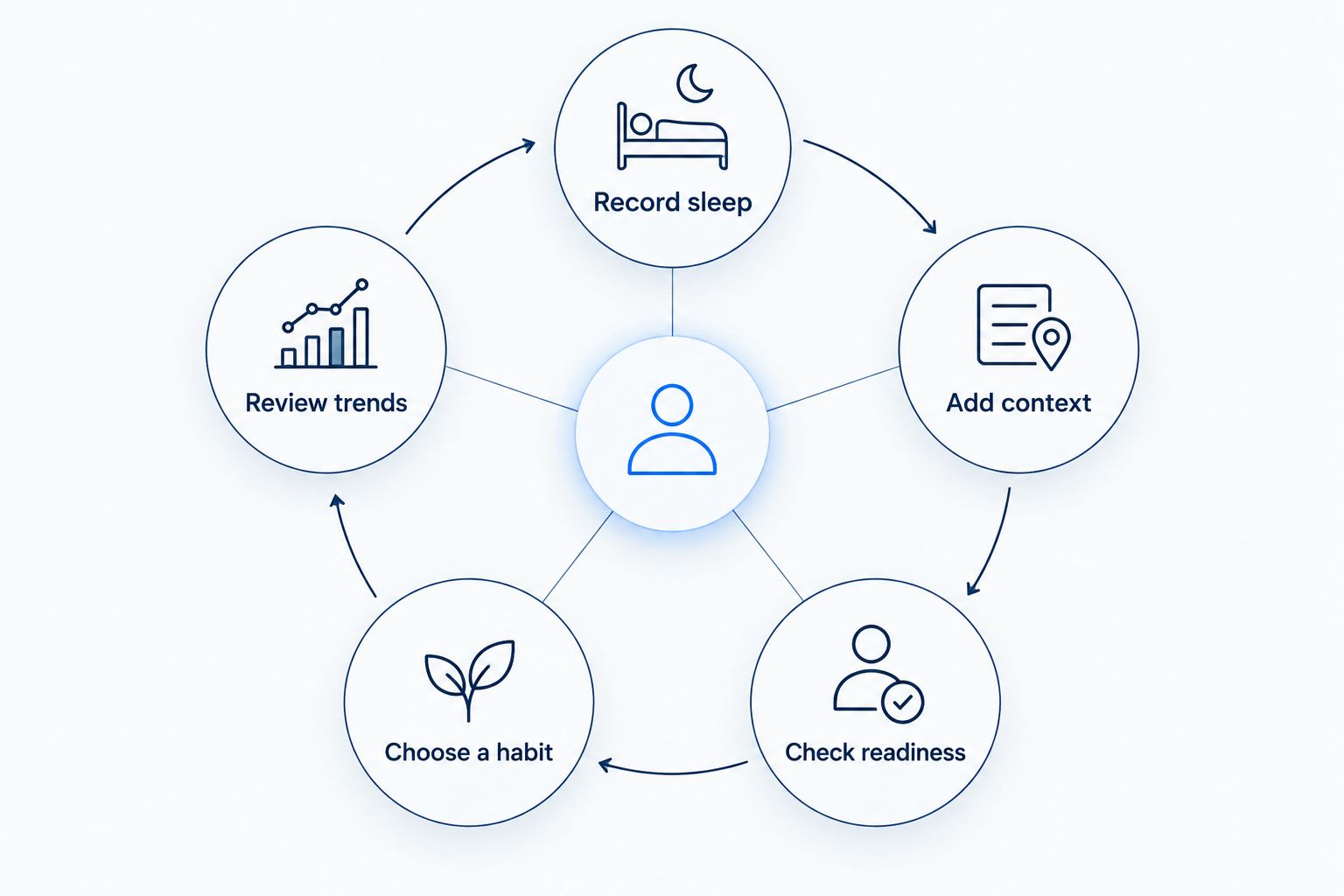
Use this sequence:
- Record sleep: Look at sleep timing and duration rather than opening with the stage chart.
- Add context: Note late sessions, travel, illness, or changes in your evening routine.
- Check readiness: Consider sleepiness, soreness, mood, and how the warm-up feels.
- Choose a habit: Pick a relevant change, such as protecting bedtime after evening training.
- Review trends: Look for a repeated pattern instead of judging the change from an isolated night.
Keep the interpretation proportionate. An improved score does not prove that a habit caused better sleep, and a poor score does not automatically require canceling training.
Persistent excessive sleepiness, loud snoring, or witnessed pauses in breathing need medical attention. A consumer tracker cannot rule out a sleep disorder.
Which sleep tracker should you choose?
Choose Hume Band 2.0 if you want sleep, activity, strain, and recovery trends together. Choose Garmin Forerunner if running-watch functions lead the decision, Oura Ring if wrist-free overnight wear matters, or Apple Watch if your iPhone routine comes first.
Keep a sleep diary alongside whichever option you choose. Context turns a chart into something you can use.
For a 2026 purchase, identify your unanswered question before replacing an existing tracker. A different device is only useful if it addresses that question or solves a wearability problem.
FAQ
What's the best sleep tracker for athletes in 2026?
Hume Band 2.0 is the default pick here for athletes who want sleep tracking alongside activity, strain, and recovery trends. Garmin Forerunner, Oura Ring, and Apple Watch suit different training or device preferences.
Is a ring or a watch better for tracking sleep?
Neither format is automatically better for every athlete. Choose a ring if you prefer wrist-free sleep tracking, or a watch if combining training and overnight tracking matters more.
Does Hume Band 2.0 require a subscription?
Core app tracking does not require a subscription. Premium coaching and deeper personalized analysis are optional paid upgrades.
Do I need Hume Pod to use Hume Band 2.0?
No, Hume Band 2.0 works on its own. Hume Pod is an optional body composition analyzer, not a requirement for using the wearable.
How much sleep should an athlete aim for?
General adult guidance recommends at least 7 hours regularly, but an athlete's needs require individual consideration. Training demands, daytime sleepiness, and recovery belong in that assessment rather than a tracker score alone.
Should I skip training after a bad sleep score?
A bad sleep score alone is not enough to decide whether to skip training. Consider how you feel, illness symptoms, the planned session, and advice from your coach or clinician.
Can a sleep tracker diagnose sleep apnea?
A consumer sleep tracker cannot replace a medical evaluation for sleep apnea. Loud snoring, witnessed breathing pauses, or persistent excessive sleepiness warrant a conversation with a clinician.
One last thing
The most useful missing data point is often context. In 2026, keep a short note explaining unusual nights beside your tracker record. Hume Health can bring sleep and activity insights together; your observations explain the schedule and habits behind those trends.